Heisenberg group as a fundamental group
In a lecture few days ago we were discussing Van Kampen diagrams. It is a diagram which represents that particular (group) given by the group presentation represents the identity element, i.e. is a relation, in that group. We were focusing on the Van Kampen diagram of the integer 3-Heisenberg group. This being a helpful visual aid to get grasp of the group better, someone asked if this is somehow related to the fundamental group? They especially asked if there exists such a topological space \(X\) that it’s fundamental group is isomorphic to the integer 3-Heisenberg group \(H_3(\mathbb{Z})\).
Proposition 1 There exists a topological space \(X\) such that \[ \pi_1(X,x_0)\cong H_3(\mathbb{Z}) \]
First thing that came to my mind is CW complexes. Especially the next theorem provided by Hatcher (2015).
Theorem 1 Every group \(G\) has a CW-complex \(X_G\) of dimension 2 such that
\[ \pi_1(X_G)\cong G \]
Proof. Choose a presentation \(\langle g_\alpha \mid r_\beta\rangle\). This exists because every group is a quotient of the free group. So we have that \(g_\alpha\) are the generators of this free group and \(r_\beta\) are the generators of the kernel of the map from the free group to group \(G\). Now construct \(X_G\) by \(\bigvee_\alpha S^1_\alpha\) with attaching 2-cells \(e_\beta^2\) by the loops specified by the words \(r_\beta\).
By Theorem 1 there exists CW-complex \(X_{H_3(\mathbb{Z})}\) such that \(\pi_1(X_{H_3(\mathbb{Z})})\) is isomorphic to the integer 3-Heisenberg group. This proves Proposition 1. With the 3 generator presentation \(\langle x, y, z \mid [x,z]=1, [y,z]=1, [x,y]=z \rangle\) this has 1-cells \(S^1_x\), \(S^1_y\) and \(S^1_z\).
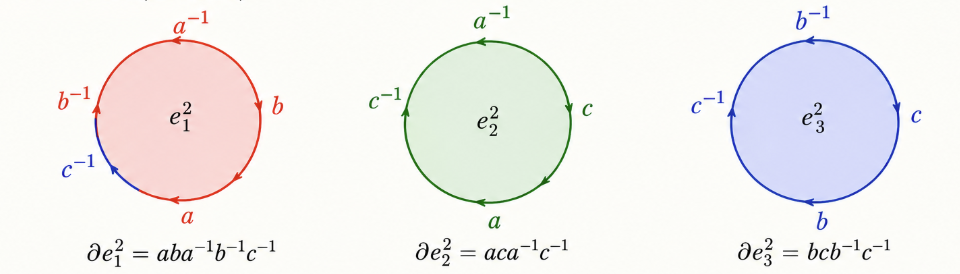
But this isn’t the only way to find a group of whose fundamental group is the Heisenberg group. We can use Hatchers books proposition 1.40 to find such a group.
Proposition 2 If an action of a group \(G\) on a space \(Y\) satisfies (*), then \(G\) is isomorphic to \(\pi_1(Y/G)/ p_*(\pi_1(Y))\), where \(p_*\) is induced by the quotient map \(p: Y\to Y/G\).
Where condition * means “Every point \(y\in Y\) has a neighbourhood \(U\) such that if \(g_1(U)\cap g_2(U)\neq \varnothing\) for some \(g_1, g_2\in G\), then \(g_1=g_2\)”.
If we set \(G=H_3(\mathbb{Z})\) and \(Y=H_3(\mathbb{R})\). The action of left multiplication is clearly free. Suppose \(\gamma\in H_3(\mathbb{Z})\) and \(M\in H_3(\mathbb{R})\). Then \(\gamma\cdot M=M\) is satisfied only by \(\gamma = I\). The discreteness of \(H_3(\mathbb{Z})\) and the freeness of the action forces the condition (*) to be true. Hence by Proposition 2 we have that \[ H_3(\mathbb{Z})\cong \pi_1(H_3(\mathbb{R})/H_3(\mathbb{Z}))/p_*(\pi_1(H_3(\mathbb{R}))) \]
Since \(H_3(\mathbb{R})\) is homeomorphic to \(\mathbb{R}^3\) and \(\mathbb{R}^3\) is contractible, then \(H_3(\mathbb{R})\) is contractible. Then obviously \(p_*\) maps it to the trivial group and hence the quotient “disapears”. So then we have \[ H_3(\mathbb{Z})\cong \pi_1(H_3(\mathbb{R})/H_3(\mathbb{Z})) \] This is another space that satisfies the Proposition 1. This space is called the Heisenberg manifold.